
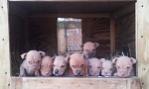
Incorrect. Jezebel, for example, was the smallest pup in her litter (Poncho/Screamer) ... and I knew she was the best pup in that litter by 4 weeks of age ... even though it turned out to be an all-game litter. Every dog in that litter had perfect (and I mean perfect) conformation. Every dog in that litter at some point got stretched out and proved to be game (honestly, except Jezebel, who waxed every dog I put her with ... including spotting weight against 2 in a row ... she waxed them both). Every dog in that litter who was bred produced winners or DG losers. So it was a helluva good litter, but still, ability-wise, Jezebel was head-n-shoulders over the others. And I could just "see" that she would be better than the rest by her intensity, by her will to dominate, by what a devious and troublesome pup she was, and by the way she moved. When the other pups would congregate at the fence "to come see me" ... little Jezebel would use them all as stepping stones and climb up on top of them ... and then she would start climbing the fence, using her arms as hands, and even her mouth to get higher-and-higher. She was always one step ahead of everyone else and she demanded to be "on top" of everything else.
So when you ask, "How can you see these things?", my question to you is, "How can you not?!" You could see Jezebel's superiority a mile away, even though she was the smallest. There was nothing weak about her smallness, she was a perfect physical specimen, that just happened to be small. Regarding small size, take a look at the most athletic human beings in the world pound-for-pound ... gymnasts ... and you will see they sure are not big people ... but you can also see the athletic superiority of a gymnast (to the common slug of a person) in the physiques gymnasts have and in the way they move
By knowing what to look for
First of all, I don't breed for mouth, I let it come and go as it pleases. Still, certain pups that come out with heavier-than-average mouth are easy to spot as the pups play with your hands; some pups clearly have leverage when they bite while others do not, and crush when they're not even trying, so that is pretty easy to see IMO. Regarding air and stamina ... I breed for air sir ... it is simply in the bloodline now (but, sure, some have it exceptionally-well while others not so much). But, here again, all you have to do is use your eyes when your puppies play ... and when you see pups with their tongues hanging out and they're huffin' & puffin' after playing ... you can pretty much figure that this is what they're going to do when they're in there for real ... and when you see pups that are tireless and breathing through their noses as they continue to romp and play-wrestle, you can pretty much figure those are the ones who will rock-n-roll tirelessly for real too. Common sense.
As for the others, ability and drive, again spotting "ability" is determined by how they move, which is what I said at the beginning. You either know an athlete when you see one or you do not. I know an athlete when I see one and I can see it by the way they move: their speed, timing, reflexes, economy of effort versus wasted effort, etc. I can't explain "color" to the color-blind. A person either can "see color too" or they cannot. I can just spot ability in a pup by the way it moves.
Regarding gameness, this trait canNOT be fully-proven in pups, but again it is BRED FOR. For example, when you have deep gameness not just in the individual you're breeding to, but deeply-rooted in terms assloads of game dogs as its ancestors, spread throughout in high percentages of littermates the individual (and not just in the dog you breed), you don't worry about gameness that much. It's just there. It's only when you're breeding "the one" game dog in his litter (where the rest quit) that you need to worry about gameness.
For example, Wildchild bought 12 dogs from me, and has shown several. Of the multiple dogs he's rolled and shown, only 2 have lost (one was with that son of Icon that he thinks he got rubbed with, who was a mile ahead and then stopped taking hold after the sponging--and then who won 2 more after that), the other was with a son of Rocko who lost DEAD GAME. All the other dogs have kicked ass and won him the money. Wildchild could hardly get a game dog before he bought dogs from me ... and he's cleared-out almost all his other dogs and is using mine now ... and now he simply is confident that his dogs will be game. You have to be selective when you breed to have confidence in gameness. This means passing up on "game dogs" if their littermates weren't game. When you breed exclusively to game dogs from game litters, and if you stick to that credo for years, you will eventually not worry about getting game dogs anymore.
You must keep in mind that there are a lot of stupid, ignorant old-timers. I have known several actually. They knew how to call a weight, and they knew certain specialty skills as it related to matches, but they really had no freakin idea how to breed dogs (which is why they bought most of the great dogs they had). I promise you, those old-timers who actually breed their own stock, and they're still winning with them, they can almost invariably select the best pups right away.
In every field of endeavor there is, everybody piggy-backs off of the great minds before them. Scientists don't start from scratch, trying to figure out what's-what. They first get trained to understand the data, the theories, and the proven facts of those before them ... and from that foundational springboard they try to advance into uncharted territory.
And so it should be with these dogs. You first learn "what you're told" by the old-timers ... then you learn to separate fact from fiction through your own experiences ... and then (once you've developed a clear understanding of your own), you begin to totally discard outmoded beliefs and practices that your own experience belies ... while you cherish the time-proven facts that stand firm to your own observations ... and then from that point you begin implementing new (or at least clandestine) practices/theories of your own. That is what I did, and that is what every thinking person does.
You will not need to write anything down, you will just know ... or not know ... depending on the level and consistency you bring to your own efforts. Sure, I write a lot and I can quantify the things that I look for in my pups, but I sure don't go out there with a list when I go to watching them. I just watch them and I know. When I have really good litters, it is always the ones where I hate myself for selling any of them
You're welcome ... and thank you for asking such interesting and poignant questions,
Jack


Reply With Quote